FDA guidance document Use of International Standard ISO 10993-1, "Biological evaluation of medical devices - Part 1: Evaluation and testing within a risk management process" is probably the most used guidance document for medical devices. It is regularly referred to during biological evaluations and FDA submissions. Many of us carrying out biological evaluations of medical devices can quote sections from it at the drop of a hat.
So, it came as a pretty big surprise when FDA announced in September that the guidance, which had just been revised in 2020, was revised again. The announcement raised questions for many in the industry regarding what changed what FDA's new expectations are regarding submissions or biological evaluations in general.
FDA guidance on ISO 10993-1 (biological evaluation of medical devices): What changed?
The biggest and the most welcome change was the inclusion of attachment G, where the long-awaited draft guidance on intact skin contact was finally incorporated into the final document. We should take a moment to celebrate this milestone, an important step forward in recognizing that some devices and some materials are simply so low risk that pre-clinical testing should not be recommended, especially using the animal models that are most often applied. With the inclusion of attachment G, from now on, when a medical device is made from recognized (listed) material(s) and has only intact skin contact, FDA will no longer require submission of test reports. This, of course, does not mean that a risk assessment is not needed to indicate low risk, but at least the debate on why we should not perform another round of irritation and sensitization testing on well-known materials can hopefully be avoided.
As stated in this new revision of the guidance document, “FDA has identified specific materials in the final finished devices that are included in the policy outlined in this attachment when they are in contact with only intact skin surfaces. The materials can include other processing chemicals and additives (e.g., plasticizers, fillers, color additives, cleaning agents, mold release agents). Except for color additives, these chemicals would not need to be disclosed in a marketing submission for devices with this type of tissue contact.”
To note though, attachment G only applies to certain materials with intact skin contact. There are many clauses written where this does not apply. For instance, neonatal skin contact is excluded from this approach due to the neonatal skin’s continued formation toward full protective barrier properties.
Another big change includes the reference to FDA’s accreditation scheme for conformity assessment (ASCA) program in the final guidance document. For the past three years the agency has run a pilot program for ASCA to test out the approach and see if it makes the submissions easier. And now, it is fully integrated as a recommendation for testing in the guidance. The aim of the ASCA program is to streamline a submission to the agency based on FDA reviewers’ enhanced confidence in test methods and results from ASCA-certified testing labs, which means fewer questions or additional information requests on test reports, sample preparation, and conformance to the standards. This, of course, does not mean that everyone will need to queue up at ASCA-certified labs and only use ASCA-certified labs or test methods for their FDA submission. Reports from labs that are not ASCA-certified for the specific tests are still acceptable. However, for those studies, the full reports are required to be submitted (which follows the previously used approach).
Table A.1 in the guidance was also updated to list the correct endpoints that are now covered in the ISO 10993-1:2018, with an X indicating the ones that are present in both documents, and an O indicating those that should be considered in addition when submitting to FDA. There were no other mentionable changes. One thing to point out is that ISO 10993-1:2018 Table A.1 separates out subacute and subchronic toxicity endpoints, whereas FDA guidance has them in the same column. This has sometimes given the impression that the expectation would be to always perform these together, but now a clarification has been added that states that the choice and/or duration of test for these endpoints should be based on the duration of device use (e.g., devices used for more than 14 days should not be assessed using a 14-day test).
Another point worth mentioning is that in the background, where lots of discussion within the ISO 10993-1 draft working group has been going on about the necessity to expand genotoxicity assessment requirement for, for instance, all direct blood-contacting devices (even with limited contact), the FDA guidance 2023 revision still stands on the position that only the blood-contacting devices that are part of an extracorporeal circuit should require this endpoint. This, of course, only applies to limited contact devices, as for prolonged- and long-term direct blood-contacting devices, genotoxicity potential should always be considered and addressed.
Another noticeable change in the main body of the text is related to comparison articles, where testing method requires or recommends the use of a comparison article. Previously, the text noted without ambiguity that for all FDA submissions a U.S.-legally marketed device must be used, and many conversations were had where alternatives from non-U.S. markets were not considered appropriate. In the 2023 revision this has been removed from the main text. Unfortunately, however, this is not yet a point of triumph, as the expectation is still present in a footnote that states that, “For the purposes of this guidance, 'legally marketed devices' are limited to devices marketed in the U.S.”
All in all, the document and guidance provided within did not change much.
Additional points to consider (although already present in the previous revision of ISO 10993-1)
Even though the changes made to the guidance were not radical (none of them significant other than the inclusion of attachment G), there are still many aspects that are good to revisit and some existing recommendations from FDA that are important to remember. While there were several great topics to choose from, we settled on Test Article Preparation for Extract Testing (which makes up a large chunk of FDA's requests for additional information), the Guinea Pig Maximization Test, Material Mediated Pyrogen (MMP), and Implantation Testing. Careful consideration of the FDA’s guidance in these areas can make a significant impact to any device submission.
Diligence in sample preparation
Preparing test articles for extract testing is unique for every medical device, so additional care in the instructions provided to the lab for this step is an important part of submitting samples for testing. For example, if there is a fluid pathway that should be flushed or filled, components that should be excluded, or if the sample should not be cut. These are just a few of the most common examples that we encounter as a testing laboratory or as regulatory consultants assisting with additional information requests during submission.
A topic for every device sample preparation is the extraction ratio that will be used. As an industry we reference ISO 10993-12:2021, specifically Table 1 (shown below).
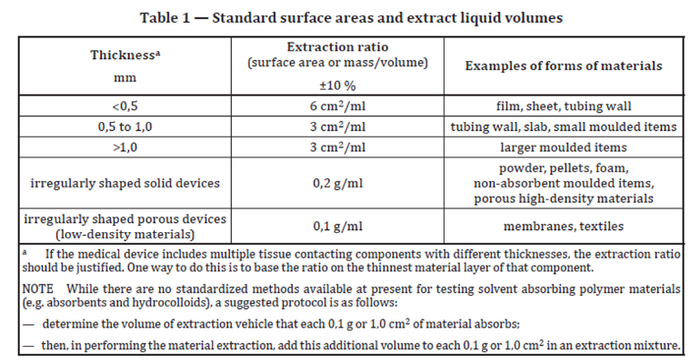
As each test performed has a minimum volume needed, this is an important initial consideration to determine if there is enough sample, where to apply the extraction fluid, and what components to include or exclude. When using the standards, it is important to understand and justify the approach used rather than randomly selecting parameters. To highlight, FDA’s guidance specifically asks for surface-area-to-volume ratios unless justification can be provided (section E). Fluid pathways that contact the patient should also be included in the extract (such as when the device has a lumen through which solutions are flushed into or onto the patient during surgery). For devices that only have indirect contact (such as syringes, external tubing intended for delivering fluid to patient, etc.), however, it is recognized that the fluid pathway typically has a very small internal surface area, much smaller than when the standard surface area ratio is applied. If the latter is used, it would lead to a much larger calculated fluid volume, which would just not fit inside the fluid path of the device. As such, the approach of “filled to capacity” has been considered as worst case for extract preparation and has often been accepted. However, it is always a good idea to demonstrate with simple math that this is indeed the case for your device.
Another important component of Test Article Preparation for Extract Testing is determining the time and temperature of the extract. Again, for the industry, we reference ISO 10993-12:2021, which allows for 37°C for 24 hours or 72 hours, 50°C for 72 hours, 70°C for 24 hours, or 121°C for 1 hour. The guidance document specifically reviews consideration for prolonged or long-term contacting devices where an extraction at 37°C may not be sufficient. This indicates that if the device has a limited (
Additionally, device indications and clinical-use scenarios may change over time. Thus, we recommend using 50°C whenever possible to avoid repeating testing. It is strongly advised that any changes to the most used extraction conditions be accompanied with a solid justification for why the altered parameters are better suited for testing and clinically representative; this will help to avoid unnecessary repetition of testing. For especially complex devices, it is also a good idea to prepare a Q-Sub or Pre-Sub application to run the chosen parameters and conditions by the agency before the testing is started.
Recording observations before and after extractions is not only listed in FDA’s guidance document, but it is also a requirement of ISO 10993-12:2021 section 11, which states, “The condition of the test extraction (color, clarity, presence of any particulates) shall also be described, and photographed if applicable).”
When issues arise with the condition of the extract, the lab should contact the sponsor to discuss and ask if the test will proceed or be discontinued. Regardless of the decision, investigation into the cause should follow. For example, if particulates are observed, they should be further analyzed to determine their source and if they would be expected clinically or if it is a residual of the sample preparation (such as cutting/bending of the sample).
Notes for Guinea Pig Maximization Test
An allowance is made in the Guinea Pig Maximization Test in ISO 10993-10:2021 for laboratories to perform positive control testing only every 6 months rather than for each testing day. FDA raises a concern that 6 months is too long to go between analysis of data. Thus, the recommendation is to ensure that the testing performed is within at least 3 months of the positive control testing. This is important information to consider, as this may require submission of further positive control data to the agency post testing to demonstrate proper control over the testing and animals.
Discussion on material mediated pyrogenicity
There has been a lot of discussion in the industry to reduce in vivo testing, in which material mediated pyrogenicity (MMP) testing has been included. Currently, this is performed in rabbits, and there is not an alternate in vitro method available that is validated for medical devices. FDA does offer the option to review chemical characterization data (if available) for known material pyrogens. However, there is a caveat with this proposal. On nearly every chemical characterization (extractables and leachables) study (also often referred to as analytical chemistry testing), there are unknown compounds which are not able to be identified using the available libraries. And while there are certain thresholds available to assess unknowns, these thresholds are not applicable to pyrogens. Therefore, while the document lists this as an option, in practice it is not possible to address the pyrogenic potential of the device without an appropriate threshold.
Considerations for Implantation Testing
As devices increase in complexity, assessing local tissue responses through implantation testing requires more initial consideration. There are standard implantation studies outlined in ISO 10993-6:2016 that indicate the species, sex, and number of animals as well as the number and size of implants to use. These studies are limited, as the recommended species is usually rabbits. While coupons can be manufactured to accommodate large devices and the small size of rabbits, in practice there is a limit to the number of materials that can be accurately analyzed; typically, no more than 4 materials may be included. A great alternative to the traditional implantation studies is to include implantation in a clinically relevant implantation study (functionality or performance testing). This requires that the laboratory performing the clinical testing review the ISO 10993-6 standard to ensure that the requirements from the standard are considered in the test protocol. Additionally, this protocol could include considerations for the assessment of additional toxicity endpoints (acute, subacute/subchronic, or chronic toxicity).
The aim of the FDA guidance document on the use of ISO 10993-1 is to provide clarity on what the agency expects for regulatory submissions. It gives pointers on risk assessments, testing to be performed, conditions for selecting and extracting devices for testing, and so on. The most significant change in the document is the inclusion of FDA’s position on intact skin-contacting materials. This is a welcome addition to ensure the reduction of animal testing, whenever appropriate. A review of the existing language in the document leads to our recommendation that the sample preparation be considered carefully and that a temperature of 50°C be used for extracts, where appropriate. More clarity in the expectations will enhance the ease of submission for both medical device manufacturers and for regulatory reviewers. We encourage making the submission process a dialogue, especially when submissions relate to complex devices, as this will lead to a better understanding of the concerns from the reviewer’s perspective and will help reviewers know how to best mitigate those concerns using the information at hand or with data to be generated.
Source & attribution: https://www.mddionline.com/regulatory-quality/fda-guidance-2023-on-iso-10993-1-what-changed-